Estadio de la Cerámica: The History of Villarreal’s Home Ground
Estadio de la Cerámica, formerly known as El Madrigal, is one of the most emblematic stadiums in Spanish football. It stands not just as a venue for matches, but as a symbol of Villarreal CF, the town of Villarreal (Vila-real), and the region’s ceramic industry. Below is an overview of how it evolved over the years.
Origins and Early Years (1923-1950s)
- The stadium was inaugurated on 17 June 1923 under the name Campo del Villarreal. The first match played was between Castellón and Cervantes.
- Just two years later (1925), it was renamed El Madrigal, after the rural area (a campo / countryside zone) where the ground is located.
- Early facilities were modest; capacity, stands, amenities etc. were minimal, fitting a small club in a small town. Over time, modest improvements were made.
Expansion, Upgrades & Mid-Century Changes
- In 1952, one of the first major renovations: the pitch was enlarged from about 95 × 50 metres to approximately 104 × 65 metres, bringing it more in line with contemporary standards (inspired by, among other things, larger stadiums like Helsinki’s Olympic Stadium).
- During the 1960s and early 1970s, further work: a covered stand was added; the southern stand (behind the goal) was completed between 1971-72.
- In 1973, floodlights were installed for the first time, enabling evening matches. The installation was supported by local authorities.
Major Renovations & Modernization (Late 20th Century)
- The 1980s saw further rebuilding: in 1988-89 the southern stand was demolished and rebuilt. The inauguration of that rebuilt portion took place 8 March 1989 with a friendly against Atlético Madrid. (Wikipedia)
- For the club’s 75th anniversary around 1998, larger scale works were done: new stands with roofs, amphitheatre-style access, VIP areas, renovation of the north stand. These were completed for the 1999-2000 season.
- Also in 2001, the tribuna preferencia (main stand) was enlarged.
Entry into European Football & Name Change
- When Villarreal qualified for European competition (Champions League etc.), the stadium had to meet UEFA standards. In 2005, modifications were made: improved dressing rooms, better facilities for press, safety, spectator separation, etc.
- On 8 January 2017, the official name was changed from El Madrigal to Estadio de la Cerámica. This was a decision by the then-club president, Fernando Roig, to both promote and pay tribute to the strong ceramics (tile) industry in the province of Castellón.
Recent Remodel & Present Day
- In 2022-2023, a major renovation was undertaken (designed by engineering / architecture firm Idom among others) to modernize the stadium:
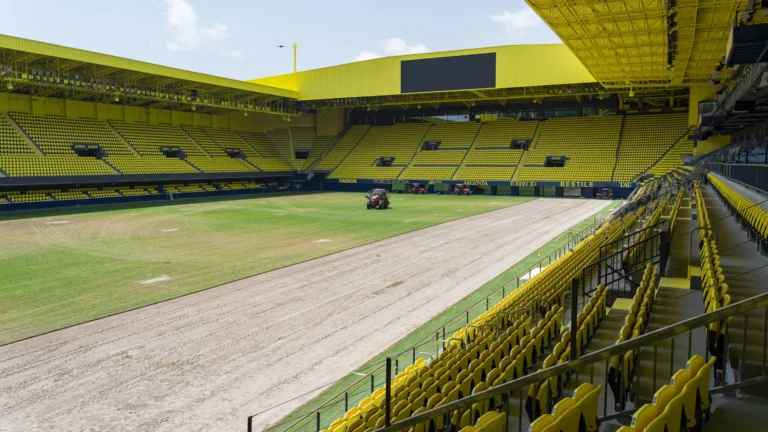
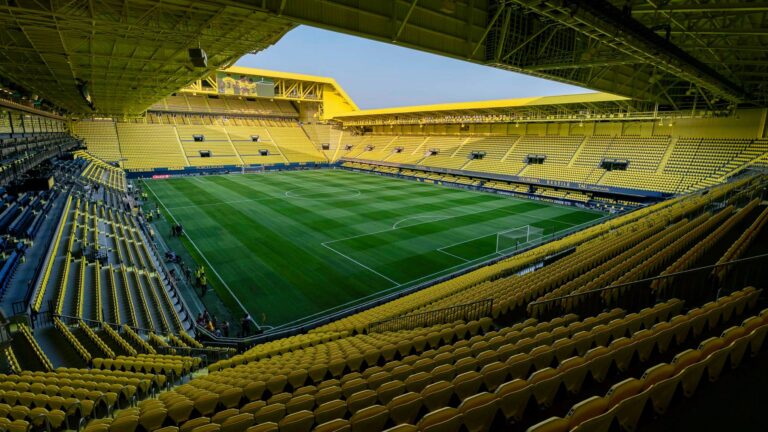
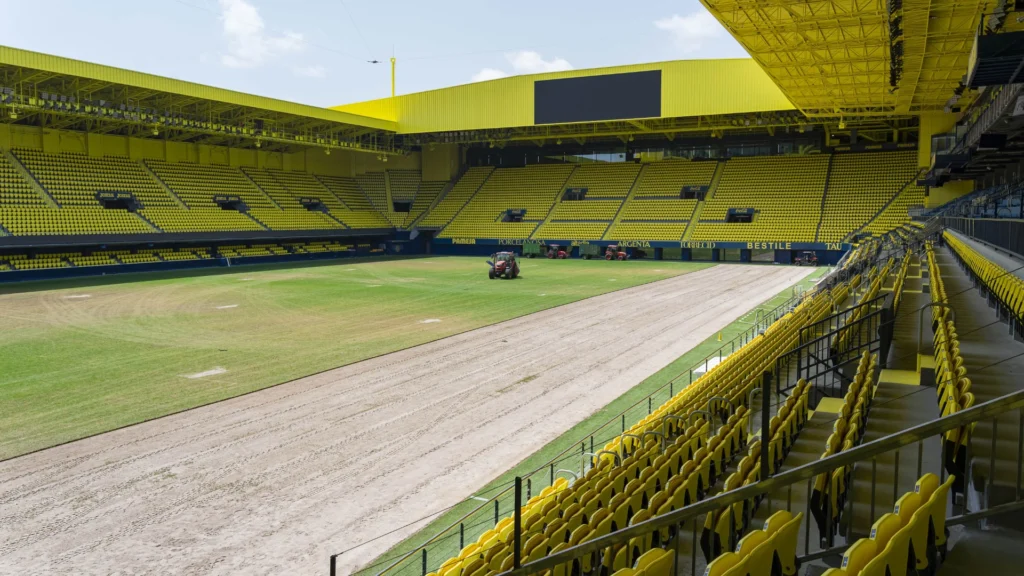
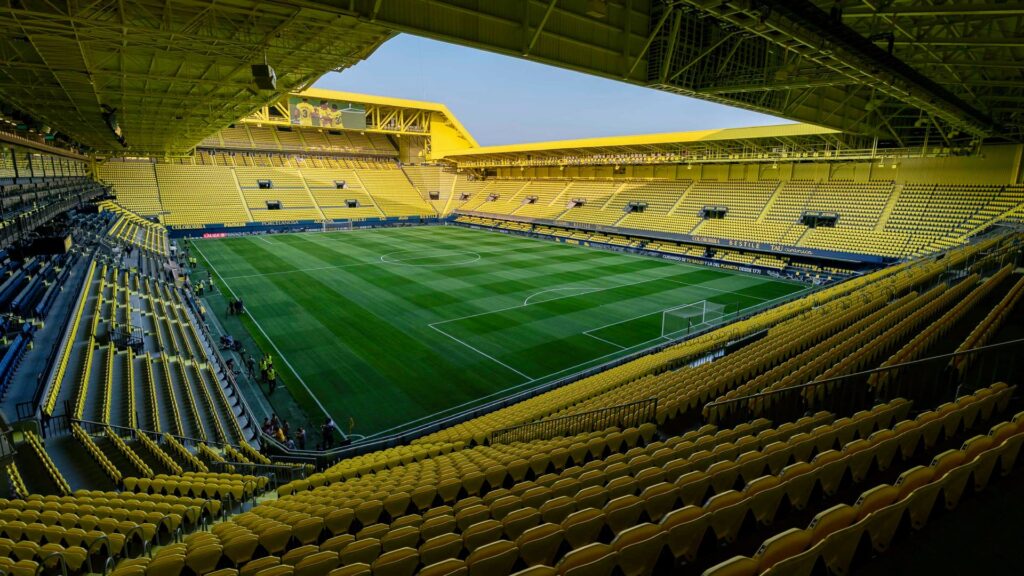
- The stadium was more fully enclosed (closing gaps between stands) so that all sections are covered by roofs.
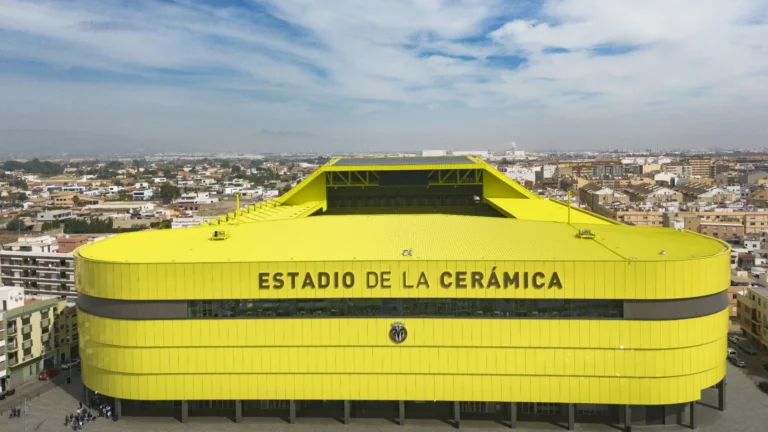
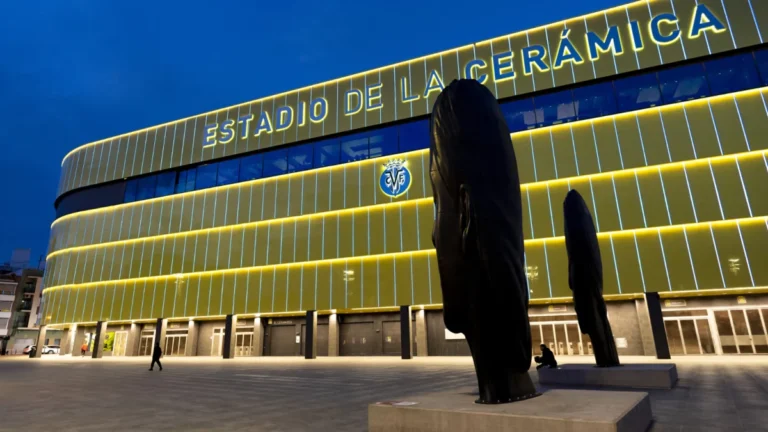
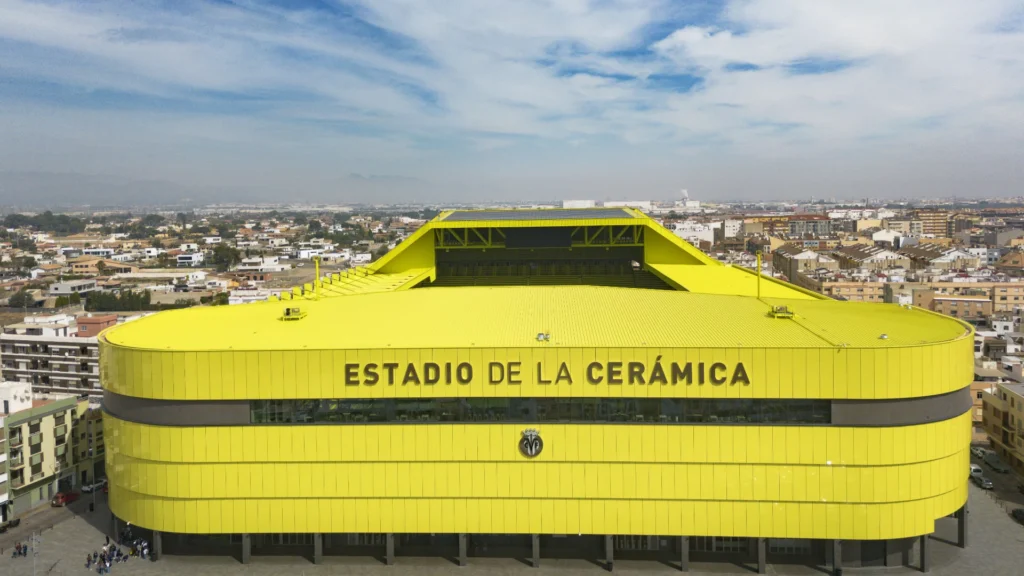
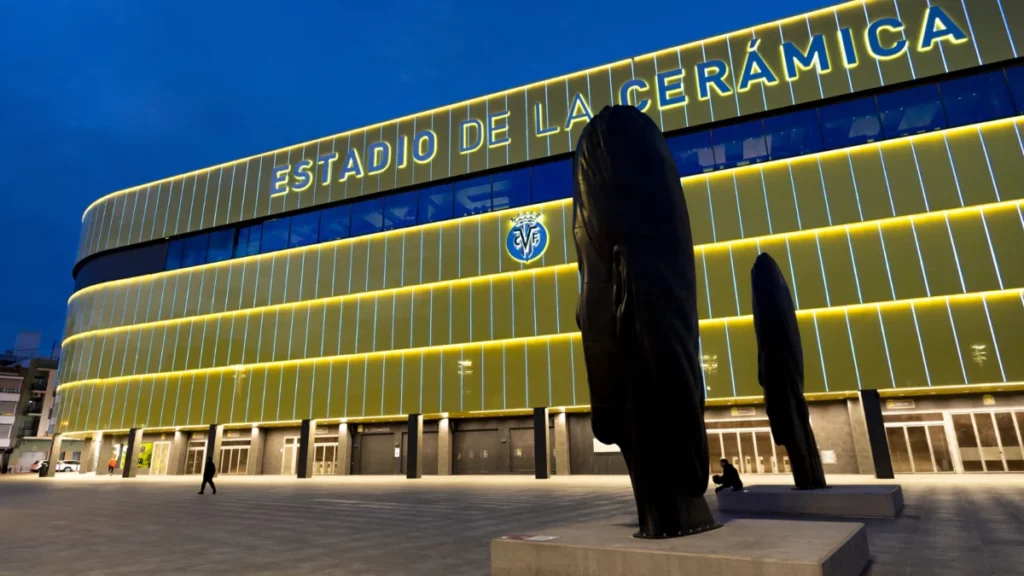
- The outer facades were redone, prominently using ceramic tiles / panels (yellow) as a nod to the local industry.
- Interior facilities were improved: better lighting, new seating, video scoreboards, updated amenities.
- When completed, its seating capacity is roughly 23,000‐23,500 spectators.
Significance & Identity
- It is one of the oldest stadiums in La Liga (top division in Spain) that still remains in its original location and serving the same club. (villarrealcf.es)
- The stadium is known by several nicknames: Feudo Amarillo (“Yellow Fief”) is one. Fans often still refer to it as El Madrigal.
- The name de la Cerámica links it strongly to the identity of Villarreal and the province: ceramics – tiles – local craftsmanship. The stadium thus serves not only as a sports venue but as a cultural and economic symbol.
Timeline of Key Dates
| Year | Event |
|---|---|
| 1923 | Inauguration as Campo del Villarreal (17 June) |
| 1925 | Renamed El Madrigal |
| 1952 | Pitch enlargement & first major renovation |
| 1960s / early 70s | Covered stand; completion of South stand (1971‐72) |
| 1973 | Installation of floodlights |
| 1988-89 | South stand demolition & rebuild, friendly vs Atl. Madrid to reopen |
| 1998-2000 | Major renovation: grandstands, roofs, VIP etc. |
| 2001 | Enlargement of main stand (tribuna preferencia) |
| 2005 | UEFA-driven upgrades for Champions League compliance |
| 2017 | Official name change to Estadio de la Cerámica |
| 2022-2023 | Comprehensive renovation: roof, enclosure, facade, internal amenities etc. |
Architectural & Design Notes
- The dimensions of the pitch are standard for high-level football: 105 × 68 metres.
- The stadium site is somewhat constrained: it is densely surrounded by urban housing; stands sit quite close to nearby streets and buildings. Because of this, expansions or changes are often limited by space.
- The ceramic façade added during recent renovations serves both aesthetic and symbolic purpose, visually tying the stadium to one of the main economic activities of the region.
Challenges & Future
- Space constraints limit how much capacity can increase without major structural changes or acquisitions of adjacent land.
- Maintaining modern standards (lighting, safety, spectator comfort, accessibility) requires regular investment. The recent renovations show the club is committed to this.
Legacy
Estadio de la Cerámica is more than simply where Villarreal CF plays its home matches. It encapsulates nearly a century of local history: the rise of a small club, the growth of the town, the development of industry (especially ceramics), and changing expectations for sports infrastructure. For fans, it is a place of memories—both modest and grand. For the city, it’s a landmark, linking tradition and identity to modern competitive sport.
Sorry, no records were found. Please adjust your search criteria and try again.
Sorry, unable to load the Maps API.