The kick everyone calls cheeky targets the one place nobody guards, because the goalkeeper has usually left it. That is the Panenka penalty: a soft, lofted chip down the middle of the goal, struck after a run-up that looks like any other shot. It is named after Antonín Panenka, who is credited with it, and the wording is deliberate. Panenka says nobody had done it before, but that is his claim, not a documented record.
My reading is that the Panenka is not a skill flex. It is a bet on what the goalkeeper will do.
Where does the name come from?
Panenka took the kick on 20 June 1976 in Belgrade, in the Euro 1976 final. Czechoslovakia and West Germany had drawn 2-2 after extra time, and the shoot-out that followed was, according to Radio Prague, the first used to decide a major international tournament final. Uli Hoeness, West Germany’s fourth taker, sent his kick over the bar. Panenka, (Czechoslovakia’s fifth), then beat the goalkeeper Sepp Maier to win the shoot-out 5-3 and the trophy. The goal was widely reported, and his surname became the name of the technique.
What actually counts as a Panenka?
Less than the label suggests. In a Twelve Yards piece of 1 February 2021, Ben Lyttleton applies three tests: the run-up, the trajectory of the ball and where it ends up. A low shot rolled down the middle fails. So does a hard strike into the top of the net. By those tests, he rules out Zinedine Zidane’s chip in the 2006 World Cup final, which he judges far too high. Wikipedia’s list of successful examples and the Guardian’s 2026 feature both count it as a Panenka.
My view is that neither side is wrong, because nobody owns the definition. Lyttleton’s tests are his own classifications, as he says. I use the strict reading here: a slow chip down the middle, already dropping as it crosses the line, off a run-up that gives nothing away.
In Czech, the kick is the Vršovický dloubák (‘Vršovice chip’), after the Prague district where Panenka’s club, Bohemians, is based according to Wikipedia) and Seznam Zprávy.
Why does a Panenka only work against a goalkeeper who jumps?
Because a chip down the middle is slow, and a goalkeeper who stays put catches it. The kick needs him to commit to a side, and one study of top-league penalties says most do.
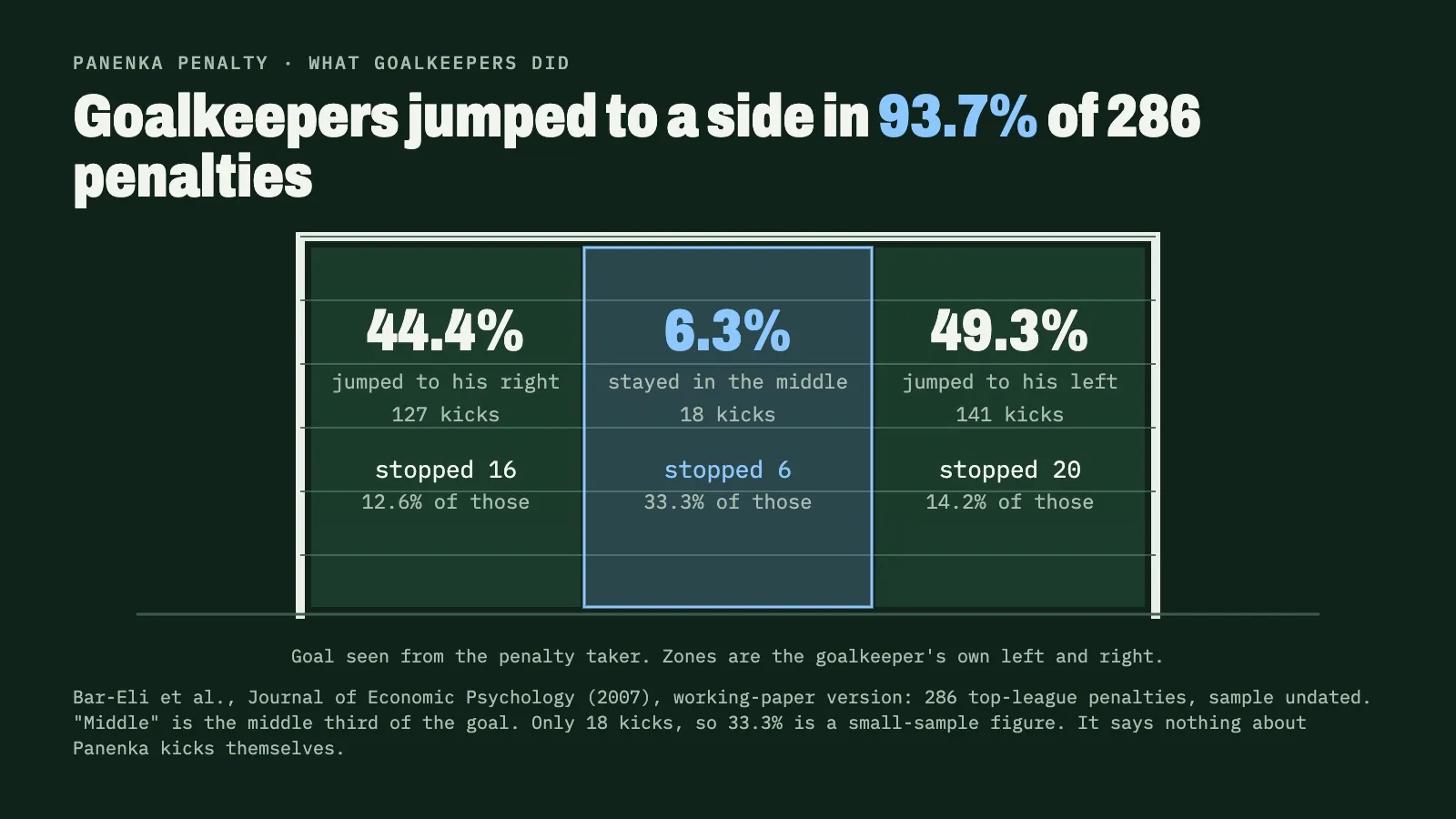
In a 2007 study in the Journal of Economic Psychology, Bar-Eli, Azar, Ritov, Keidar-Levin and Schein coded 286 penalties from top leagues and championships worldwide, taken from archived TV broadcasts. The left and right panels are from the goalkeeper’s point of view, and the figures come from the authors’ working-paper version.
| Goalkeeper action | Share of the 286 kicks | Kicks stopped | Stop rate |
|---|---|---|---|
| Jumped to their left | 49.3% (141) | 20 | 14.2% |
| Stayed in the centre | 6.3% (18) | 6 | 33.3% |
| Jumped to their right | 44.4% (127) | 16 | 12.6% |
Add the first and third rows, and goalkeepers jumped to a side in 93.7% of kicks. Its limits:
- Only 18 kicks saw the goalkeeper stay. Six stops out of 18 is far too small a sample to call 33.3% a general rate.
- The study does not say which seasons or leagues the 286 kicks came from, so the sample is undated.
- “Centre” covers the middle third of the goal, not the exact middle. A true Panenka is only part of that zone. The 82 kicks in that zone made up 28.7% of the total.
- Goalkeepers who jumped stopped 36 of 268 kicks, 13.4% (my calculation from the table).
The authors blame action bias: the pull toward doing something even when doing nothing would serve better; a goal conceded after standing still feels worse to a goalkeeper than one conceded after diving. The numbers fit that story, but the explanation is the authors’ interpretation; the kick data did not measure it.
My take: this explains the target, not the technique. It shows why a goalkeeper is likely to be out of position, and says nothing about how well anyone chips.
How often does a Panenka work?
I found no sourced success rate for the Panenka alone, so we can explain why it can work but cannot say how often it does.
What exists is hedged and does not settle it:
- Ignacio Palacios-Huerta of the London School of Economics told the Guardian’s Sean Ingle (10 May 2021, read in a syndicated copy) that in his dataset the scoring rate of a true Panenka was statistically similar to other penalties, although slightly lower, and could be 4-5 percentage points lower than the average penalty kick. He said the small number of Panenkas makes his estimates tentative, and still called it not a terrible idea. The piece gives no dataset, definition of a true Panenka or sample size.
- Jamil, Littman and Beato (2020) studied 1,716 penalties in the big four European leagues from 2015/16 to 2018/19. A “chipped (Panenka type)” strike was one of the coded variables, and it was not statistically significant in any of the four leagues. Not significant is not the same as no worse, and their regressions covered scored penalties only, so they give no conversion rate for a chip.
The Premier League’s own penalty data, from 2006/07 to December 2024, shows where the ball went rather than how it was struck. Low corner zones converted at 78.4% to 80.4%, high zones at 95.7% to 97.3%. The page itself says precise Panenka records do not exist, so these figures describe zones and say nothing directly about the Panenka.
What do the Laws of the Game allow?
All of this is under the Laws of the Game 2026/27, which change each 1 July. Check Law 14 before relying on it.
Feinting in the run-up is permitted. Feinting once the run-up is complete is not. If the kicker does it and still takes the kick, he is cautioned for unsporting behaviour, any goal is disallowed, and the defending team gets an indirect free kick, one from which a goal cannot be scored directly. If the kicker feints and never touches the ball, he is cautioned and the kick is retaken. The Laws do not define “completed the run-up”. That is the referee’s call, so I would not claim to know where the line sits.
In a shoot-out, under Law 10 (2026/27), illegal feinting means the kick is recorded as missed, and the kicker is cautioned.
A second touch is a separate matter. The kicker may not play the ball again until another player has touched it. A deliberate second touch is an indirect free kick, or a direct one for a handball. So if the ball comes back off the post or bar, the kicker must wait for someone else to touch it; playing it first is an indirect free kick. A rebound from the goalkeeper is different: the kicker can play it again.
Accidental double touches are treated differently. If the kicker catches the ball with both feet at once, or it hits the non-kicking leg immediately after the kick, a goal means a retake. No goal means an indirect free kick in a match and a miss in a shoot-out. IFAB Circular 31, dated 2 June 2025, dealt with this case.
Is it disrespectful?
Some thought so. The Premier League’s December 2024 feature says the kick was praised in some quarters for its ingenuity but reviled by others, who suggested he sought to ridicule the goalkeeper unsportingly. In the Guardian’s 2021 piece, Panenka says he saw himself as an entertainer who wanted to give fans something new to see.
The other story is political. After the final, Panenka was told he could have been punished had he missed, because it might have been seen as disrespecting the Communist system. When Lyttleton asked what sort of punishment, the reply in the 2021 Guardian piece was 30 years working down the mines. FourFourTwo in July 2026 has him saying a factory or a mine for 50 years. It is his recollection; the two retellings differ, and I found nothing that documents any actual sanction.
Panenka, then 77, told the Guardian‘s Gavin Newsham on 20 June 2026 that he likes the “falling leaf” description of the kick: “It works so beautifully.”
What should you remember?
The Panenka only works if the goalkeeper commits first. In a 2007 study of 286 penalties from top leagues, with no dates given for the sample, goalkeepers jumped to a side 93.7% of the time. Only 18 stayed, and “centre” meant the middle third of the goal. That explains why the kick can work. It does not say how often, and I found no published rate for the Panenka alone. To judge a taker’s choice, look at the goalkeeper’s move first.